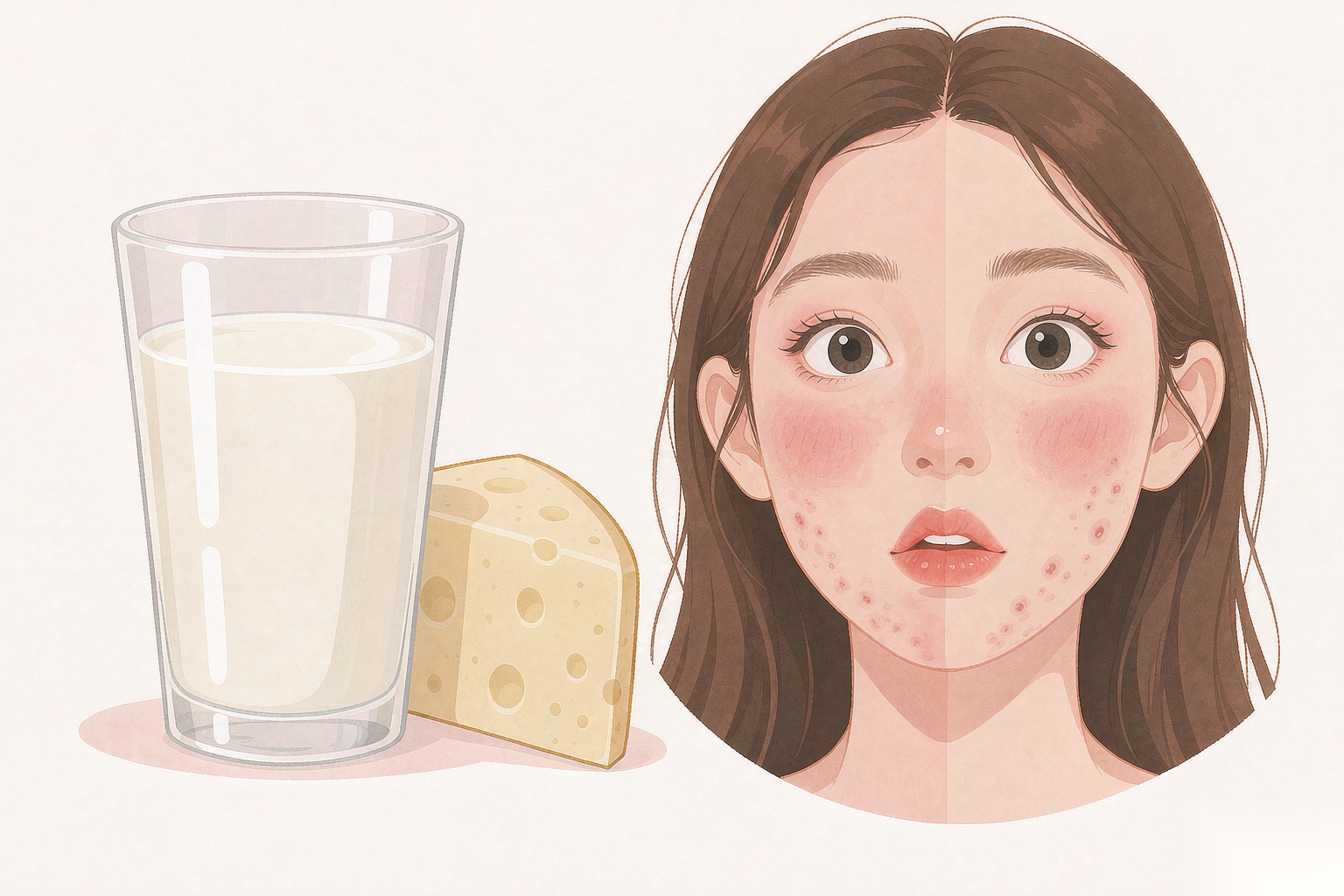
Few food questions cause as much household debate as this one. Someone quits milk and swears their skin cleared within a month. Someone else eats cheese every day with a flawless complexion. Both stories get dismissed as anecdote, yet the research on dairy and skin has quietly matured into something more nuanced than either camp admits. The short version: the dairy-skin link is real for some people, it is strongest with a specific type of dairy, and the gut is the reason the same glass of milk can affect two faces so differently.
What the research actually shows
The evidence comes mostly from large observational cohorts, and the pattern within them is surprisingly consistent. Across studies following tens of thousands of teenagers and young adults, total dairy consumption shows a modest link to acne, but the association strengthens when researchers isolate milk specifically, and it appears in skim milk as strongly as, or stronger than, in whole milk. That detail matters. Whatever is going on, it is probably not the fat itself, since removing the fat does not remove the signal. Meanwhile, cheese and fermented dairy show weak or no consistent association in most analyses. If dairy affects your skin, it is most likely milk and its liquid proteins, not the aged cheddar on your sandwich.
The hormone pathway: IGF-1 and whey
Milk is a growth signal by design. It is meant to turn a calf into a cow, and it delivers that message through hormones and growth factors that survive processing. Drinking milk raises levels of insulin-like growth factor 1, or IGF-1, in your bloodstream. IGF-1 does several things acne cares about: it pushes oil glands to produce more sebum, it accelerates the turnover of the cells that line pores, and it amplifies the effect of androgens, the hormones already known to drive breakouts. Whey protein concentrates this effect. Whey is rich in leucine, an amino acid that directly stimulates the molecular machinery IGF-1 activates, which is why whey supplements have repeatedly been linked to acne flare-ups in bodybuilders and gym-goers. Casein, the other milk protein, raises IGF-1 less sharply, one reason fermented dairy behaves differently.
The gut angle most people miss
Here is where the two-people-one-milk-glass puzzle gets its answer. What your body does with dairy depends heavily on your digestive tract. Lactose digestion, the balance of your gut bacteria, and the integrity of your intestinal lining all shape the downstream response. In people whose gut microbiome handles dairy smoothly, the hormonal bump is transient and the inflammatory response stays quiet. In people with dysbiosis or a stressed gut barrier, the same meal can produce a larger, longer inflammatory ripple, and the skin registers it. Fermented dairy complicates the story in an interesting way: the fermentation process consumes much of the lactose, produces bacterial enzymes, and in some studies delivers probiotic effects that reduce systemic inflammation, which may explain why yogurt and kefir do not track with acne the way milk does.
Running a fair two-week dairy experiment
If you suspect dairy, the worst way to test it is to quit everything vaguely dairy-adjacent for a day and judge by tomorrow’s mirror. Skin cell turnover works on slower cycles than that. A cleaner experiment looks like this.
| Step | What to do |
|---|---|
| Baseline week | Keep your usual diet and note breakout patterns in a simple daily log. |
| Removal weeks 1-2 | Cut milk and whey protein completely. Keep cheese and yogurt if you want, or cut all dairy for a cleaner signal. |
| Watch weeks 3-4 | Skin keeps improving for weeks after the change. Judge the trend, not day-to-day noise. |
| Reintroduction | Add milk back alone. If breakouts return within one to two weeks, you have your answer. |
Two practical notes for the removal phase: replace the calories and calcium with real food, and read labels, because whey and milk solids hide in protein bars, shakes, and many packaged foods. A hidden dose on day nine can quietly ruin a clean experiment.
Where a targeted probiotic fits
Whatever you decide about dairy, the gut half of the equation is worth supporting, because it moderates how strongly your skin reacts to everything, dairy included. Eating fermented foods, feeding your bacteria with varied fiber, and taking a well-formulated multi-strain probiotic all lower the baseline inflammation that turns small dietary triggers into visible breakouts. Strains such as Lactobacillus rhamnosus and several Bifidobacterium species have human data behind them for inflammatory skin conditions. A gut-skin formula like PrimeBiome packages those strains with prebiotic fiber, which is the pairing that makes them stick.
Beyond breakouts: dairy and other skin complaints
Acne gets the headlines, but the dairy question touches other skin conditions too. Eczema researchers have looked at dairy for decades with mixed results; some children with atopic dermatitis flare with milk, while controlled trials of dairy elimination in unselected eczema patients show little benefit, which suggests the effect exists only in a sensitive subset. Rosacea presents a similar picture: red wine is the notorious trigger, but some patients also report flushing after hot milk or aged cheese, and the mechanism there may be as much vascular as microbial. The pattern across conditions is the same as with acne: a minority of people react meaningfully, most do not, and there is currently no reliable lab test to predict which group you fall into. That is exactly why the structured reintroduction experiment remains the most informative tool, and why cutting all dairy forever on the basis of one online list is usually more restriction than the evidence supports.
Bottom line
Dairy is not a universal acne trigger, but milk and whey deserve a fair trial if your breakouts resist every topical you have tried. The mechanism is hormonal, the variability is gut-deep, and the test takes four honest weeks. Run the experiment, keep your topicals steady, and support the gut that decides how loudly the signal gets through. For more on the science, browse our Skin and Gut Health sections, or explore a gut-skin formula like PrimeBiome that works from the inside out.