A course of antibiotics can be exactly what your body needs, and nobody should ever skip one a doctor prescribed to protect their complexion. But plenty of people notice something else in the weeks that follow: skin that misbehaves. Breakouts in unusual places, eczema that suddenly itches harder, a dullness that no moisturizer seems to fix. That is not your imagination, and it is not bad luck. The same drugs that cleared the infection also rearranged your gut microbiome, and your skin keeps score when that happens. The good news is that the rebuild is straightforward if you know what the ecosystem needs.
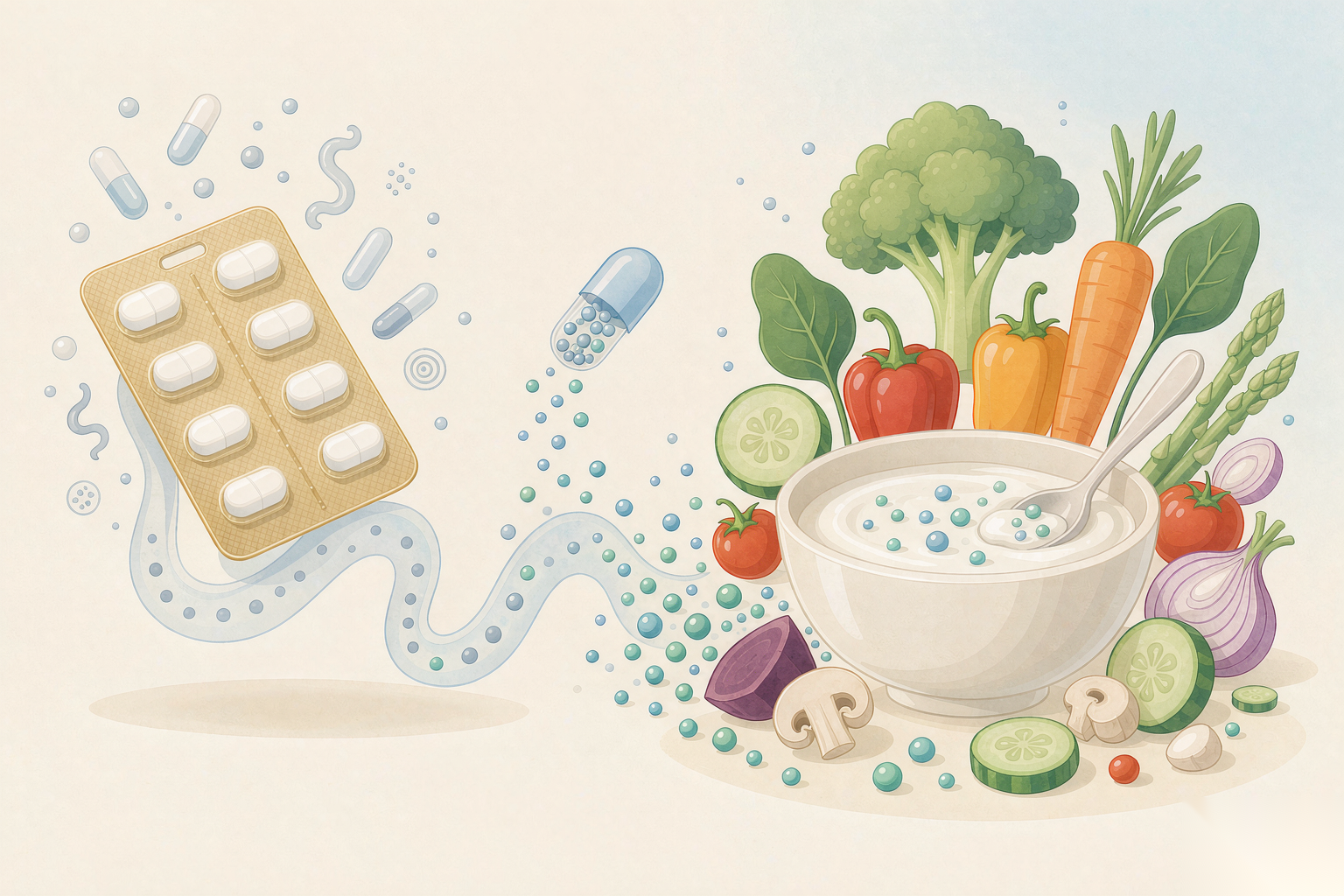
What a course of antibiotics does to the gut ecosystem
Your gut holds one of the densest microbial communities on Earth, and a single course of broad-spectrum antibiotics treats it like a forest clearing. Studies tracking people through treatment show that bacterial diversity drops sharply within days, and some species stay depleted for weeks after the last pill. The loss is not random. Antibiotics tend to knock down the slow-growing, fiber-fermenting, anti-inflammatory residents hardest, while faster-growing opportunists recover first. The ecosystem does rebuild on its own eventually, but the months right after a course are a window when the community is unstable and easy to influence, in either direction.
Why your skin feels it
The connection runs through the same gut-skin axis that governs breakouts and flare-ups the rest of the time. A depleted, dysbiotic gut produces fewer short-chain fatty acids, the anti-inflammatory compounds that keep the intestinal lining strong and the immune system calm. The barrier loosens, bacterial fragments slip into circulation, and the body responds with a low-grade inflammatory hum. The skin, loaded with its own immune cells, is one of the first places that hum becomes visible: more redness, slower healing, oil production drifting out of balance. On top of that, some research suggests the skin’s own microbiome shifts in parallel, since gut and skin microbial communities communicate through the immune system. A disrupted gut during antibiotic recovery is, functionally, a disrupted skin environment.
Why breakouts sometimes follow treatment
There is a specific reason acne-type breakouts can appear after antibiotics, even antibiotics once prescribed for acne. When the bacterial ecosystem thins, yeast and opportunistic bacteria that were previously kept in check can expand. On the skin, an overgrowth of Malassezia yeast is linked to a folliculitis pattern that looks like uniform small bumps rather than classic pimples. In the gut, a relative bloom of certain organisms can nudge inflammation upward systemically. Neither effect is dangerous, but both are annoying, and both tend to resolve as microbial diversity returns. The practical takeaway is not to panic-treat the skin with more aggressive topicals, but to shorten the window by rebuilding the gut deliberately.
Rebuilding: what actually moves the needle
Recovery is less about a single miracle food and more about giving the remaining beneficial bacteria the conditions to repopulate.
- Fermented foods daily. Yogurt with live cultures, kefir, sauerkraut, kimchi, and miso reintroduce a wide variety of organisms. A Stanford trial found that a diet rich in fermented foods measurably increased microbial diversity and lowered inflammatory markers in just ten weeks.
- Diverse fiber at every meal. Different bacteria eat different fibers, so variety matters more than quantity: oats, beans, onions, garlic, asparagus, berries, and whole grains each feed a different corner of the ecosystem.
- Feed the leftovers, not just the newcomers. Prebiotic fiber helps whatever beneficial bacteria survived the course re-establish before you add new ones on top.
- Go easy on sugar and alcohol. Both favor the opportunistic species you do not want blooming while diversity is low.
| Week after antibiotics | Focus |
|---|---|
| Week 1 | Structured fiber at every meal, fermented food once a day, minimal alcohol and added sugar. |
| Week 2 | Add a multi-strain probiotic with food; keep widening the plant variety, aiming for 25 to 30 different plants across the week. |
| Week 3 | Keep the routine steady; most people notice digestion settling and skin looking calmer here. |
| Week 4 | Maintain the habits long term. Diversity rebuilt is only diversity kept if the diet stays varied. |
Probiotics after antibiotics: timing and strain choice
Whether to take probiotics during the course or after it has been debated, and the honest answer is that both can help, just differently. Taking probiotics alongside antibiotics may reduce the risk of antibiotic-associated diarrhea for some strains, while taking them after the course ends focuses on restoring diversity. What matters most is strain selection and consistency. Strains with reasonable human evidence for gut restoration include Lactobacillus rhamnosus GG, Saccharomyces boulardii, and several Bifidobacterium species, taken consistently for at least four weeks rather than for a few scattered days. Pairing a multi-strain capsule with prebiotic fiber gives the incoming bacteria something to live on. A formula designed around the gut-skin axis, such as PrimeBiome, bundles those pieces so the rebuild does not depend on you getting the pairing right from a crowded supplement shelf.
Signs your rebuild is working
Recovery is easier to stick with when you know what progress looks like, and it rarely shows up first on the skin. The earliest signals are digestive: bowel movements that become more regular, less bloating after meals, and fewer of the odd, isolated reactions to foods that normally agree with you. Within two to three weeks, most people notice energy steadier across the afternoon and sleep feeling less fragile. Skin changes arrive last, usually between weeks three and six, because the visible layer of skin reflects conditions from weeks earlier. If your digestion is improving but your skin has not caught up yet, that is the expected sequence, not a sign the plan failed. One caveat worth respecting: if symptoms run the other direction, meaning worsening pain, blood, or fever after antibiotics, that is not a microbiome issue to self-manage. That is a call to your doctor, promptly.
Bottom line
Antibiotics do a job your body sometimes genuinely needs, and the skin changes that follow are a temporary ecosystem problem, not a verdict on your health. Flatten the inflammation by feeding the bacteria that remain, reintroduce diverse strains through food and a well-chosen probiotic, and hold the routine for at least a month. Your gut recovers first, and your skin follows. For more on the science, browse our Gut Health and Skin sections, or start the rebuild with a gut-skin formula like PrimeBiome.