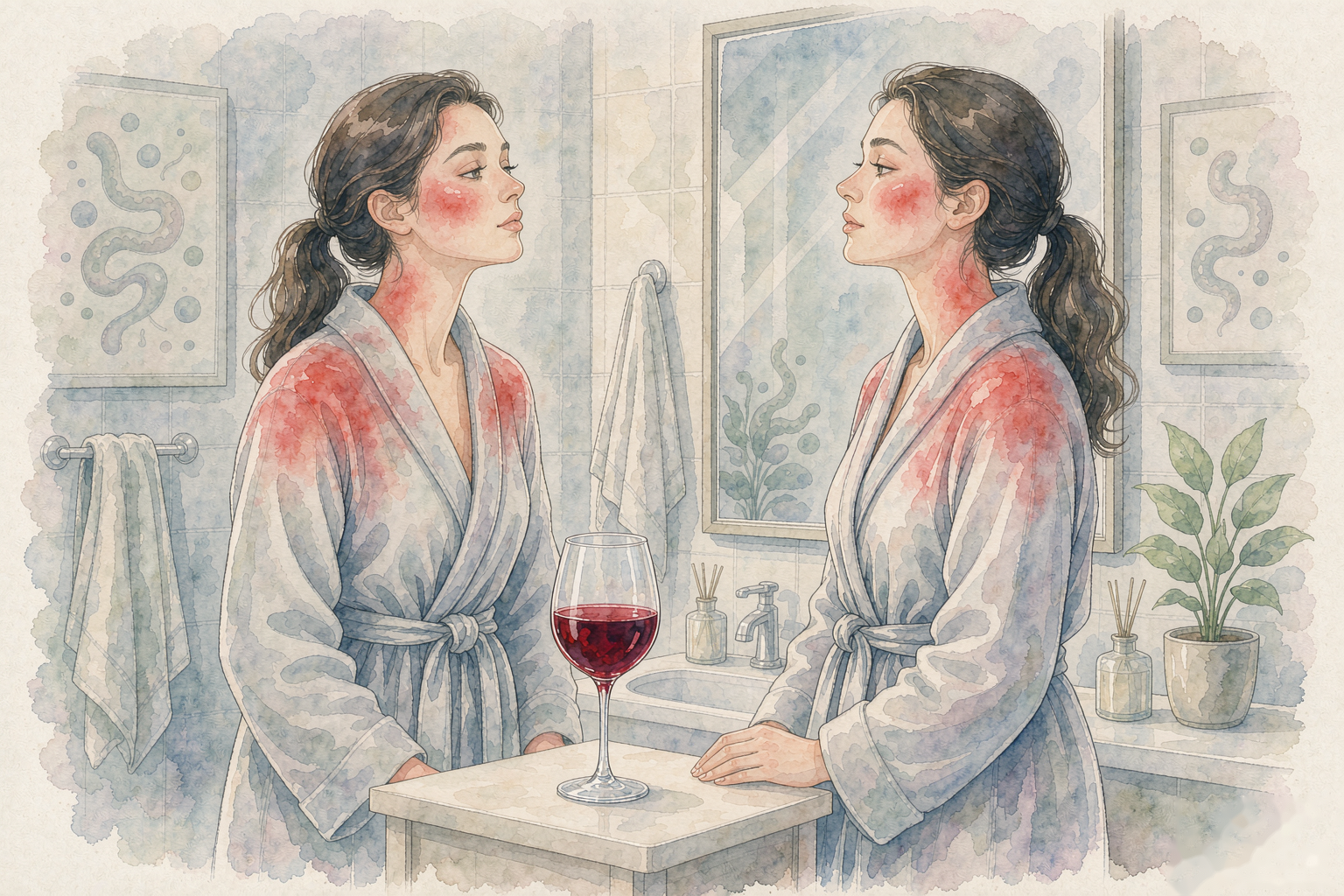
You know the look. One glass in, your cheeks feel warm. Two glasses in, the flush has spread across your nose and chest. By the next morning your skin is puffy, uneven, and strangely dull, no matter how much water you drank before bed. Most of us blame the alcohol for dehydrating us and leave it there. The fuller explanation is more interesting, because the redness and the dullness are not only a surface story. Alcohol works on the gut first, and through the gut it reaches the skin.
What alcohol does to the gut microbiome
The gut is the first stop for every drink. Alcohol is a solvent, and the bacteria that live in your digestive tract are sensitive to it. Regular drinking tends to reduce microbial diversity and shift the balance toward species associated with inflammation, while the beneficial fiber-fermenting bacteria that produce short-chain fatty acids decline. Because those fatty acids are what keep the gut lining sealed and the immune system calm, losing them matters. Alcohol also slows the movement of the digestive tract in some people and speeds it in others, and it irritates the stomach lining directly. None of this stays confined to the gut, because the microbiome is one of the main levers controlling how much inflammation circulates through the rest of the body.
The leaky-gut route to flushed skin
When the gut barrier weakens, bacterial fragments such as lipopolysaccharides cross into the bloodstream. The immune system recognizes them as a threat and releases inflammatory messengers, including histamine, which is exactly the compound responsible for the redness, itching, and warmth of a flush. Alcohol compounds the problem in two ways. It loosens the junctions between the cells that line the gut, making the barrier more permeable for hours after drinking. It also interferes with the enzyme that breaks histamine down, so the histamine released by the drink and by the gut lingers longer than it should. The result is the classic alcohol flush, and for people who already have rosacea or reactive skin, it can trigger a flare that lasts well beyond the evening.
Why your face looks worse the morning after
The morning-after face is a predictable sequence. Vasodilation widens the blood vessels, producing puffiness and a red, blotchy tone. Poor sleep, which almost always accompanies a late night of drinking, reduces the skin’s overnight repair and raises stress hormones that increase oil production. Dehydration shows up as fine lines that look deeper and a complexion that reads as gray rather than glowing. And the inflammatory load you created in the gut is still circulating, so the skin stays reactive and uneven for a day or two. It is not a mystery, and it is not permanent. It is an acute, alcohol-driven version of the same gut-skin axis that runs in the background every day.
The long view: accelerated aging and barrier damage
Occasional drinking leaves a temporary mark. Heavy, regular drinking leaves a more lasting one. Chronic alcohol exposure is associated with increased oxidative stress and a rise in the enzymes that break down collagen and elastin, the proteins that keep skin firm. Over years, that translates into earlier wrinkles, sagging, and a barrier that recovers more slowly from sun and irritants. The gut contributes to this as well: a persistently inflamed, dysbiotic gut keeps sending inflammatory signals to the skin, which is one reason heavy drinkers often look older than their years.
| Drink | Rough effect on the gut-skin axis |
|---|---|
| Red wine | Contains histamine and sulfites, common triggers of flushing and rosacea flares. |
| Beer | High in gluten and often histamine; the volume of liquid adds to puffiness. |
| Spirits | Higher alcohol concentration per serving stresses the gut lining more sharply. |
| Sweet cocktails | Add a sugar load that feeds the inflammatory and glycemic side of the loop. |
Does any alcohol treat skin better than another?
Honestly, no drink is good for skin, and the “red wine is healthy” framing has been overstated. If you are going to drink, the least irritating options are the ones lowest in histamine and sugar, sipped slowly and always with food and water. But the more useful message is that the dose and the frequency matter far more than the type. A single glass once a week is a small signal; several drinks most nights is a chronic one that the gut and the skin both register.
Repairing the gut-skin axis after a heavy season
The gut microbiome is resilient, and it can be rebuilt. Give it fiber from many plants, fermented foods daily, and a break from alcohol that lasts long enough for the barrier to seal again. Reintroduce the bacteria that were depleted with a multi-strain probiotic containing Lactobacillus and Bifidobacterium species, and pair it with the prebiotic fiber those strains need to establish themselves. A formula built specifically for the gut-skin axis, such as PrimeBiome, is a practical way to speed that recovery rather than waiting weeks for the microbiome to find its own way back. Hydration, antioxidant-rich foods like berries and green tea, and a sunscreen you actually wear will handle the surface while the gut does its work underneath.
Who notices alcohol in their skin the most
Some people wear a single drink on their face immediately, while others seem to escape with no visible trace at all. The difference comes down to a few factors. People with rosacea or a naturally reactive complexion have blood vessels that dilate more easily, so the flush arrives sooner and lingers longer. Those with a histamine intolerance, or a gut that is already inflamed, react more strongly because they start from a lower tolerance for the compounds alcohol releases. Genetics matter too: variants in the enzyme that clears acetaldehyde let the toxic byproduct of alcohol build up, producing the classic facial flush seen in many people of East Asian descent. And anyone whose baseline microbiome is depleted, whether by antibiotics, chronic stress, or a low-fiber diet, has less reserve to absorb the disruption. Knowing which group you fall into helps you decide how much care your skin actually needs.
Bottom line
Alcohol reaches your skin through your gut. That is why the flush, the puffiness, and the dullness arrive together, and why they fade fastest when you support the barrier and the microbiome rather than only the surface. Dial back the frequency, drink with food and water when you do, and rebuild the gut with fiber, fermented foods, and a targeted probiotic. For more on the science, browse our Gut Health and Skin sections, or explore a gut-skin formula like PrimeBiome that supports the axis from the inside out.