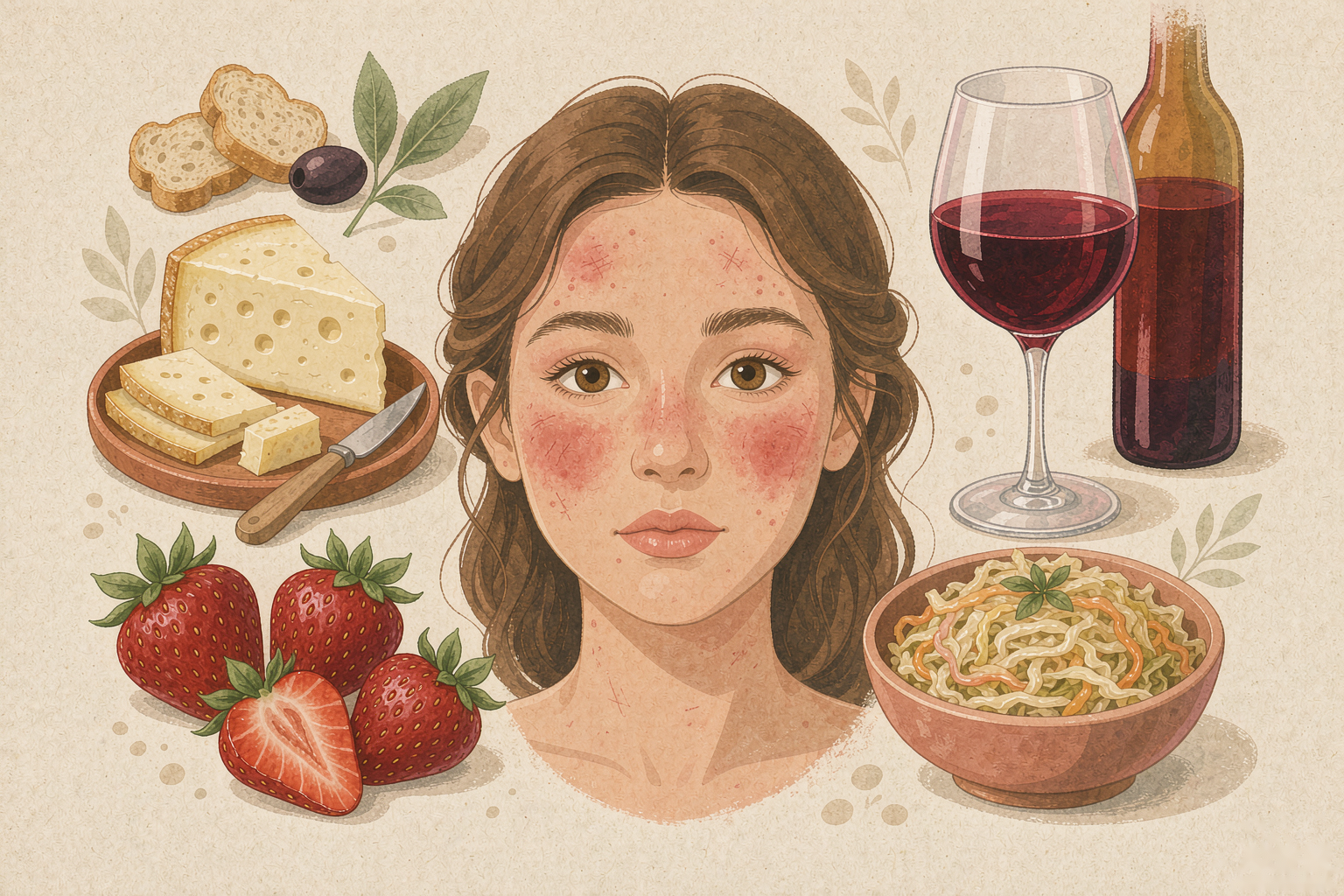
The cheeks go red after a glass of red wine. The chin itches within an hour of aged cheese. The eczema patch behind the knee flares on weeks when nothing topical changed. People who live with this kind of unpredictable skin reactivity usually blame the last thing they ate, and they are often right, but rarely for the reason they think. The molecule behind many of these reactions is histamine, and the organ that decides how much of it circulates is not the skin. It is the gut.
What histamine actually is
Histamine is not a villain. It is a signaling molecule your immune system uses for exactly the reactions that protect you: opening blood vessels, summoning immune cells, making you itch so you scratch away an irritant. Your body produces it in controlled bursts, uses it, then dismantles it with enzymes, mainly diamine oxidase, known as DAO, which works in the intestinal lining, and histamine N-methyltransferase, which works inside cells. The system is designed for balance. Problems start when the amount of histamine arriving through food and gut production exceeds what your enzymes can clear, and the surplus circulates. Skin, with its dense network of blood vessels and mast cells, is one of the loudest places that surplus gets announced.
Why the gut sits at the center of it
Three gut-related factors stack together. First, some foods deliver histamine directly: aged cheeses, fermented foods like sauerkraut and kombucha, cured meats, alcohol, and certain fruits such as strawberries and citrus are the heavy hitters, and histamine content rises the longer a food is aged or stored. Second, some gut bacteria manufacture histamine themselves, and a dysbiotic microbiome can tilt toward histamine-producing strains. Third, the intestinal lining is where DAO does its clearing work. When that lining is inflamed or damaged, DAO output drops, and the same meal that was harmless before suddenly produces symptoms. This is why gut problems and skin reactivity so often travel together, and why people notice their food reactions multiplying after a stressful stretch, a course of antibiotics, or a bout of gastroenteritis.
How it shows up on skin
Histamine-driven skin reactions have a recognizable texture. Flushing that arrives in patches or waves, itching without a visible rash, hives that appear and dissolve within hours, and eczema that flares after meals rather than after weather or product changes. The timing is the telltale: reactions typically appear between twenty minutes and a few hours after a high-histamine meal, rather than days later like a true allergy would. Many people with this pattern have normal allergy test results, because the problem is not an allergy to a specific food. It is a capacity problem, where the total histamine load across a day exceeds the clearance available.
Running a low-histamine experiment
The standard clinical approach is a short elimination and reintroduction trial, done with real food rather than guesswork.
| Foods to reduce for two weeks | Generally well tolerated |
|---|---|
| Aged cheeses, cured meats, fermented vegetables, kombucha, alcohol (especially red wine), canned fish, strawberries, citrus, tomatoes, spinach, leftovers older than a day | Freshly cooked meat and fish, rice, quinoa, most fresh vegetables, apples, pears, blueberries, eggs (as tolerated), fresh milk (as tolerated) |
Keep everything freshly cooked during the trial, because histamine multiplies as food sits, even in the fridge. If skin calm improves noticeably across the two weeks, reintroduce one category at a time and watch. The goal is never a permanent low-histamine diet, which becomes nutritionally narrow fast. The goal is finding your personal threshold and, more importantly, fixing the clearance side so that threshold rises over time.
Probiotics and histamine: the strain paradox
This is where supplement shopping gets genuinely tricky, because probiotics are not uniformly helpful here. Certain strains, including some Lactobacillus casei and Lactobacillus bulgaricus strains, are histamine producers and can make things worse. Other strains have been shown to degrade histamine or downregulate the immune signaling that releases it, including Bifidobacterium longum, Bifidobacterium infantis, and Lactobacillus rhamnosus. Choosing a formula without checking strains is a coin flip. The smarter play is a multi-strain formula that names its strains and avoids known histamine producers, paired with the fiber and gut-lining support that lifts DAO capacity over time. A gut-skin formula such as PrimeBiome is built around barrier repair and inflammation control rather than fermentation, which is the right emphasis for reactive skin.
Beyond the plate: habits that raise your histamine load
Food is only half the ledger. A few everyday factors quietly add to the circulating histamine total. Stress is a big one: emotional stress triggers mast cells to release histamine directly, which is why flush-prone people often flare hardest at the end of a hard week. Leftovers matter more than most people expect, because histamine-forming bacteria keep working in the fridge, so yesterday’s cooked chicken carries measurably more histamine than the portion you ate fresh. Several common medications interfere with DAO or with histamine breakdown, including some non-steroidal anti-inflammatories, certain antibiotics, and some blood pressure drugs, which is worth a conversation with your pharmacist if reactions appeared after starting a new prescription. Finally, the clearance enzymes depend on nutrients like vitamin B6, copper, and zinc, so a diet that is repeatedly skimpy on those cofactors lowers your ceiling. None of these levers requires perfection. They simply explain why two identical meals can produce two different faces on two different days, and why gut support compounds the benefit of any low-histamine diet.
Bottom line
If your skin reacts to meals rather than to weather, products, or stress patterns, histamine is one of the first suspects worth investigating, and the investigation starts in the gut. Reduce the incoming load briefly to confirm the pattern, eat food fresher, then work on the clearance side: a calmer, more diverse microbiome and a better-supported intestinal lining. For more on the science, browse our Gut Health and Skin sections, or support the system with a gut-skin formula like PrimeBiome that works from the inside out.